The daily struggle of finding something to wear hidden amongst a year’s worth of garments is an unnecessary battle. But with a little forethought and some planning, your wardrobe can be transformed from garment jungle to serene oasis where everything has its place.
Seasonal storing of your clothes isn’t just about making your wardrobe look like the kind of kind space you see on minimalist blogs, it’s also a great way to keep your clothes in the best condition while weeding out ones you no longer wear for eBay or local charity bins.
To avoid moths, mould, dust and simple wear and tear, here are some of the best ways to store your unworn clothes and keep them in peak condition during the off-season.
Vacuum packing
Vacuum packing – sealing away your clothes in airtight bags – not only protects your clothes but also creates a lot more space in your wardrobe, which will inevitably make things easier whenever you need to get ready. Because the bags are see through, you can easily keep track of trans-seasonal items on the off-chance of cold-fronts or heatwaves.
On the downside, they can occasionally need resealing and don’t allow the clothing to breathe. They’re also not ideal for delicate clothing and can often trap in moisture, although including silica crystals in the bag can help prevent this.
Cloth storage bags
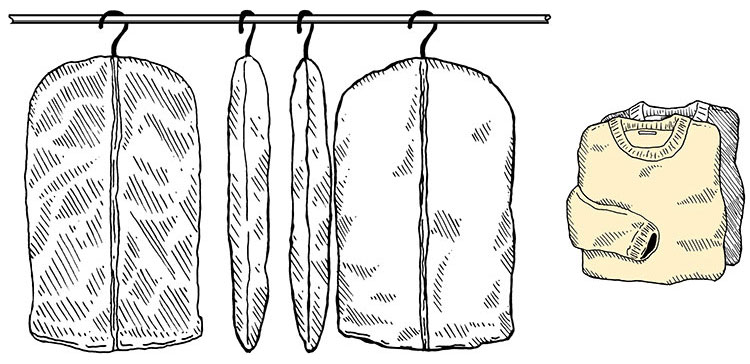
Not as convenient space-wise as vacuum packing, using 100% cotton or wool bags is much safer for delicate clothing as they allow the clothes to breathe. Wrapping clothes in tissue paper will also prevent them from yellowing and snagging on zippers or other clothes while in storage.
Storage bins
Storage bins can be an easier alternative to vacuum bags but the irony is that they require a fair amount of storage space themselves.
Storage bins are perfect for stashing summer clothing, like excess tees and shorts, and more hardwearing garments such as jeans. Using silica gel sachets will also help prevent moisture from developing mould.
Cedar, not mothballs
The scent of mothballs is at once distinct, hard to remove and never pleasant. Invest in a natural alternative such as cedar blocks that not only smells great, but works just as well, if not better, at preventing damage from moths and silverfish. Cedar hangers are also great for suits, helping to absorb moisture from daily wear.
If you're storing leather or fur, however, cedar can actually dry the fibres out. Use sachets of lavender instead.
The Wake Up and Care for Wool Show with Frances
How to store wool
Tips for storing wool clothes
Always clean your garments before storing – this helps prevent odours, stains and build-up of dirt.
Fold, rather than hang. This will help garments retain their shape while in storage.
Check on your garments every now and then and make sure no moisture has appeared or any insects have crept inside.
MORE CARE TIPS
Wool care
What is pilling?
Pilling (sometimes referred to as bobbling) is the formation of fuzzy balls on the surface of wool clothing, and often results in an unsightly or worn out appearance.
Wool care
Caring for wool
Irrespective of which method you use to wash wool clothes, it is recommended that garments are turned inside out before washing wool. This will prolong the item’s ‘as new’ look and feel.
Wool care
How to wash wool
Washing wool is easy. Wool is naturally stain resistant, odour resistant and also crease resistant, so actually requires less washing. This means that caring for wool is both easy and gentle on the planet. But when it is time to wash wool clothes, you can either wash them in a washing machine, or hand wash with ease.
Wool care
The best way to remove stains from wool clothes
Do you have stained clothes? Never fear, this easy guide by Woolmark will let you remove stains with ease to have clean, stain-free clothes in no time.
Wool care
Cleaning wool shoes
Washing your wool shoes has never been easier. Follow this simple guide to wash your wool shoes to keep them looking and smelling clean.
Wool care
How to wash and dry wool blankets
Wool blankets are among the most durable and desirable of all bedding. They're soft and warm, and are very difficult to stain or damage. Wool blankets are also very easy to care for and you don’t need to wash them often, in fact, it’s best to wash them sparingly and some guidelines recommend washing wool blankets once every three months.
Wool care
How to repair wool
The art of repairing clothes may have declined with the rise of fast fashion, but here at The Woolmark Company we believe you should love your clothes for a lifetime. Not only will repairing your clothes allow you to get more use out of your favourite wool socks and sweaters, it also means less waste in landfill. Follow these simple steps to repair your wool garments.
Wool care
Washing Merino wool socks
Unlike other fibres, wool resists odour, meaning you don't need to wash wool socks as often as other socks. But in case you do, be sure to follow these helpful tips.
Wool care
Washing wool pants
Merino wool is an excellent fibre for producing clothes, as it not only offers breathability, but has natural stretch and recovery, great drape and outstanding wear performance. Despite being a resilient fibre, a little bit of TLC will ensure your wool clothes will last for a very long time.
Wool care
Tumble drying wool
Can wool clothes go in the tumble dryer? Always check your wool garment’s care claim before putting in the dryer. If in doubt, flat-dry your woollens.
Wool care
How do I dry wool?
Drying your favourite wool sweater - or any other wool garment - is easy. Follow these simple steps and your clothes will look, feel and smell as good as new in no time.
After washing your wool clothes, it is recommended the garments – particularly knitwear such was sweaters - are dried flat, unless your garment’s care claim states it can be tumble dried. Wovenwear such as tailored suit pants or jackets can be hung up on a hanger and dried out of direct sunlight. Not only does air drying save on your energy and electricity bill, it's less impactful on the environment too.
Wool care
How to iron wool
Can you iron wool? Yes, but you want to make sure you are following Woolmark's recommended steps so you don't ruin your beautiful wool clothes.
Wool care
How to wash a wool sweater
You’ve bought it, bagged it, and worn it: now it’s time to wash your favourite wool sweater, but you think you don't know how. Never fear, washing wool has never been as easy if you follow our go-to guide to washing wool.
Wool care
How to dry a wool sweater
Drying your Merino wool sweater is just as important as washing it. A certain level of care must be taken when drying wool clothes, to ensure they retain their as-new look and feel.
After washing your wool sweater, it is recommended the sweater is carefully dried flat, unless your sweater’s care claim states it can be tumble dried.
Wool care
Best detergent to use when washing wool
What is the best wool wash detergent to use when washing your wool clothes? Follow the Woolmark guide to the best wool detergents to use to care for your wool clothes so that they last a lifetime.
Wool care
Can you dry clean Merino wool?
If the care claims on your Merino wool garment states the item can be dry cleaned, it is safe to take it to a professional dry cleaner.
Wool care
Washing instruction symbols explained
Ever wonder what those washing tag symbols and instructions actually mean? Woolmark.com has created a video and guide so you can wash and dry your clothes safely.